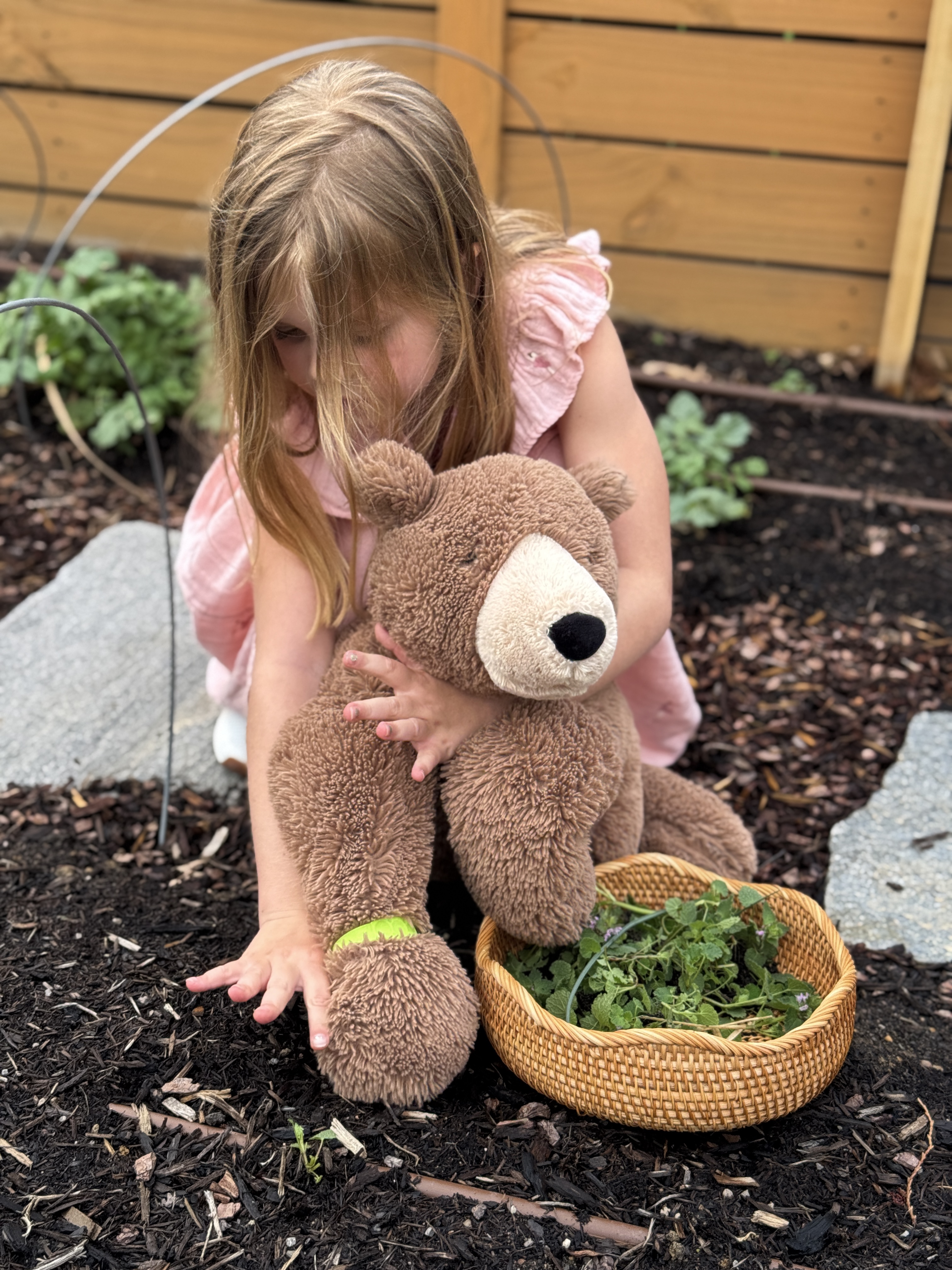
I had a fascinating conversation with my six-year-old daughter the other day when I was explaining my first assignment for Climate Farm School. I told her that I needed to create a plan for the future of our food system in 2040, and that I thought we needed to start by rebuilding our soil. Her quick and flippant response (very characteristic of a first grader) was, “That’s easy—just don’t put anything bad in it.” When I asked her to elaborate on her solution, she continued, “If you put chemicals in it, things won’t be able to grow as well as they’re supposed to because chemicals hurt the seeds and the dirt. You can put compost in it—fruit peels, apple cores, and other things like that—but no trash! Compost will make the garden grow.”
Sometimes there is truth in the simplest things. She is, of course, correct, and although we grown-ups like to complicate things, the first step to creating a sustainable, healthy, planet-loving, regenerative food system is to not put chemical fertilizers in our soil and to drastically reduce how much we plow it. Healthy soil needs humidity and structure. Plowing exposes soil to the sun, and pesticides applied to plowed soil kill 70% of the living organisms in it. First, we need to plant “healing plants” such as flowers that accumulate minerals, attract a large biodiversity of animals and insects, and build soil structure. Then we can plant other crops in these more fertile soils and help sequester carbon in the soil, not letting it into the environment.
I was shocked to learn that food production is responsible for one-quarter of the world’s greenhouse gas emissions (including deforestation, methane from animals and rice, cropland and pasture soils, manure management, and biomass burning). And this unsustainable food system doesn’t even feed everyone nor can it keep up with future demands. So how can we grow more nutrient-dense, better-tasting food and reduce our impact on the planet? There won’t be one single solution that solves the entire climate or food crisis, but rather many solutions that will each solve a portion of it. We need a shift in perspective.
Essentially, we need to curb our demands on the food system: buy only what we need; grow only what we need; reduce food in landfills; increase our “appetite” for sustainable food. We need to remember that we didn’t inherit this land from our ancestors, but instead we are borrowing it from our grandchildren. I didn’t realize how much of a hippie I was until I left California (ironically) for Ohio. Moving to the Midwest was eye-opening for me on many levels. I am continually shocked at how hard it is to find fresh, local, organic produce in a state that is more than 50% farmland. More than 75% of the arable land in the Midwest is used for corn and soybean production, leaving only 25% dedicated to other crops. The crops that humans eat. Midwestern corn fields are predominantly used to feed cars and cows. If we would devote more resources and land to growing food for humans, not animal feed and automobiles, we could reduce greenhouse gas emissions, feed more people, eat a healthier, more plant-based diet, and take necessary steps towards a regenerative agriculture system that protects our natural ecosystems — one that works WITH the environment instead of against it. As Dr. Jonathan Foley from Project Drawdown has explained, we are trapped in a food system that isn’t the best system for anyone—farmers or eaters. We are also marred by heavy-handed policy that encourages corn production mostly used for biofuels, with government subsidies that give preferential treatment to only a FEW farmers. Our goal should be to allow farmers to do more with what they have available. All the elements and creatures of the land need to work in harmony, not work for the highest yields at the lowest costs.
Here’s what we need to do…
· We need to switch from large-scale, conventional monoculture to farming organic seeds on a fraction of the land, coupled with legislative packages to back up these transitions and an infrastructure to support them.
· We need to create a delicately engineered use of the land that intertwines crops and livestock with wild habitats, even though that might look a bit wild or haphazard.
· We need to gather data inside the soil on nutrients and water levels, so we can reduce unnecessary water use and target the use of fertilizer.
· We need to use farming practices that consider local nuances and promote biodiversity, storing carbon rather than releasing it into the environment.
· We need to reduce deforestation, which is driven predominantly by animal agriculture
· We need to create a global shift to more plant-based diets along with huge reductions in food waste and loss
And here are some very important ways that will help us get there…
· Better access FOR EVERYONE to farm-fresh, local, organic produce; if it’s easier to buy nutrient-dense vegetables and they taste better, we’ll eat more of them! Locally in central Ohio, I buy most of my produce from Yellowbird Foodshed, a CSA (community shared agriculture) that aggregates food from many farms in the area and delivers it directly to your door. This way, I support local farmers, I cut out the middle man, and I know exactly where my food is coming from. The Chef’s Garden, also in Ohio, ships their just-picked produce nationwide.
· More programs like the Edible Schoolyard Project and the Edible Schoolyard Training Program, founded by Alice Waters in Berkley, CA; to truly make an impact on our future, the learning needs to start with our kids, ideally right in their schools.
· Collaboration and knowledge sharing around alternative farming practices that can be profitable, while promoting equality for all farmers, such as the work Leah Penniman is doing at Soul Fire Farm.
· Support for companies like Lundberg rice, who are drastically reforming the rice industry (a common cause of excess water use and greenhouse gas emissions) by using cover crops to restore nutrients to the soil and natural fertilizers from chicken litter.
· More local gardens; I created my backyard garden and greenhouse with the help of the fabulous Katie Carey at Columbus Foodscapes (who always reminds me that we’re “dreaming big!”) to support my culinary business, Croute—artisanal sourdough pizza catering and cooking classes in Columbus, Ohio (@croutefarmhouse on Instagram). My goal is to help bring the farm to the table in Ohio, help people here make better choices about the food they eat, and encourage them to cook more. (Unfortunately, Columbus is the fast-food test market capital of the U.S., and our community is littered with fast-food restaurants at every turn. But this mission helps me get out of bed every morning.)
When I asked my daughter where we should get our food from in the future, she confidently declared, “You shouldn’t go to the store because you don’t know if that food is from a garden. You should either go to a garden and pick carrots and peas and strawberries and eat them from the garden, or you can make your own garden.” And as it turns out, she was right on the nose once again.
Let’s start the conversation now! I’d love to learn about other ways we can collectively transform our food system. Please share them with me in the comments, if you’re so inclined (I know that you’re all smart and have ideas, just sayin’…)
 What's in My Purse
Pingback: Can Bread Save Us?