Can Bread Save Us?

A close-up of two freshly baked sourdough loaves cooling on a wire rack, showcasing their crusty exterior and inviting texture.
Sourdough loaves, fresh from the oven

For my first assignment at Climate Farm School, I was tasked with thinking about the future of our food system in 2040—what would it look like and how would we get there? For my final assignment, after spending an inspiring, life-changing week on the Ballymaloe organic farm in Ireland with a group of amazing, like-minded change makers, I’ve been asked to create an action plan to make that happen. Piece of cake, right? Ha! But actually, to me it’s more like a piece of bread…

Looking back on my initial thoughts, I wouldn’t change anything. All of the points I made are still very relevant and valid. I just need to figure out my place within the puzzle pieces. How can I be an agent of change? What is my purpose in life? What is my place in this ecosystem? Where can I plug in with my skills? Where can I add the most value? In what area(s) can I make the biggest impact? All super easy questions that we ask ourselves every day. 😉

To do this, I needed to work backwards. I needed to recalibrate my success metrics. I needed to stop worrying about HOW much of an impact I would make and just decide WHERE I wanted to make that impact. Ultimately, I can’t control or create all of the impact that I want to have. I just have to do the thing. And for me, that means baking and teaching people how to bake sourdough bread. So in essence, I just need to bake the bread. “If you build it, they will come,” is a ridiculously overused expression, but one that actually makes a lot of sense to use here. Let me explain. 

Tackling food systems change is a Herculean task. It is overwhelming and feels untouchable. But on the last day of our on-farm week, I was lifted up from the floor of despair by my classmates, who reminded me (not so subtly!) that the change starts with us. A diversity of approaches, professions, and solutions need to come together to make change. And that change isn’t going to start from above—i.e. legislature, the Farm Bill, Big Ag, etc. etc.—it has to start on the ground, with us. Only a few hours before this pivotal “lightbulb moment” happened in the classroom, I was sprayed with cow poo while in the diary milking cows. I couldn’t help but think that the universe was telling me something. The expression, “When the sh-t hits the fan…” came to mind. But I don’t think I was prepared for the emotion that would unravel inside of me, or for the epic camaraderie that would ensue around me. After the heartfelt encouragement from my peers (and a lot of tears), I was able to see more clearly. I realized that I needed to bring a little bit of the Ballymaloe magic home with me. I needed to build a Bread Shed, similar to theirs, in my backyard—a dedicated place where I can bake sourdough and teach my community how to bake it themselves.  I envision a space with lots of action and good energy that brings people together—literally and figuratively—to break bread. I think we can all agree that we could use more of that in our lives these days. 

I’ve also thought a lot about how our food system can integrate more indigenous wisdom. Sourdough is, in essence, a return to ancestral ways of cooking and feeding ourselves. As a bread naturally leavened through fermentation, it not only tastes better but is also better for our digestion than an overly-processed, store-bought alternative. It also presents an opportunity for sourcing locally-milled, nutrient-rich, organic grains (including more resilient grains like buckwheat, spelt, Khorasan wheat, etc.)—encompassing another arm of sustainable food systems. 

My plan combines Cooking + Education: I’m a chef and a teacher. The impact I can make is with the mouths that I feed and the hands that I teach, especially the little hands. 

I’ve been baking sourdough bread for 10 years—my journey started at Ballymaloe Cookery School in the spring of 2015 and continued in spades when I returned home to San Francisco and learned from the talented minds and hands at Tartine Bakery. In times of joy, sadness, celebration, or just because, I find that there are few things more powerful or memorable than giving someone a loaf of fresh, homemade sourdough bread. During Covid’s sourdough craze, I sent sourdough starter kits all over the country to friends, friends of friends, and Instagram followers so they could begin their sourdough journeys—feeding their families and hopefully finding some comfort during uniquely challenging times. The photos, messages, and videos I received of their progress warmed my heart, and reminded me that I was on the right path.  In my Bread Shed, I’d like to have a communal sourdough starter to which anyone is welcome at any time. Our ancestors often baked bread in a communal oven, why not do that AND share our starter. (The biggest barrier to entry for baking sourdough is maintaining a starter, so let’s change that.) 

Conversion — of both the land and our minds — needs to be local.

A close-up view of healthy, vibrant green spinach plants growing in well-kept soil, with droplets of water on the leaves, indicating freshness.
The first heads of lettuce popping out of my garden this spring

The principle of food sovereignty reinforces our right for empowerment over our food choices. My ultimate goal (and potentially my purpose in life) is to help people make better choices about the foods they eat and to connect them to where their food comes from. We can reduce food waste by cooking more creatively and effectively, and by making better choices when shopping for food. (Alarmingly, about 1/3 of the world’s food is wasted each year, 40% of which is wasted at the retail or consumer level.) Last fall, I planted the first literal seeds to grow my own food. This spring, the fruits of my labor popped their heads out of the ground, green and beautiful. If even a handful of the people in my community or my classes decide to also start growing their own food, we will be making impactful steps towards building a more sustainable food system on many levels AND reducing food waste (no plastic packaging; food stays fresh in the garden until you eat it instead of growing old in the back of your refrigerator). Covid was also a time when many people first realized how messed up our supply chains are, with empty grocery store shelves and food overflowing at farms without proper distribution channels. Let’s change that, too. 

The Standard American Diet (SAD) is just that—sad. And even more disheartening is the fact that the Farm Bill, which favors large-scale commodity farmers and promotes growth of a handful of commodity crops used in processed foods and animal feeds, both funds an important nutrition assistance program AND ensures that the bulk of the calories purchased with SNAP are cheap and unhealthy. We need to reduce dependence on these subsidies and empower communities to make better food choices through education and accessibility.

“It is our belief at Climate Farm School that nothing shifts hearts and minds better than direct experience.”

Since that day in the classroom, I’ve said to myself many times, “Plant a seed. Stay the course. We are the people who will make things change.” Please come over and bake bread with me. I can’t wait to get our hands messy together, and make some impactful changes for generations to come. 

Every good plan needs some action items! Here are mine:

· Meet with OOT Box (who luckily happen to be my neighbors) — to build my Bread Shed

· Talk to Daniel Callen at Ballymaloe — to gain insight on how they developed their Bread Shed

· Build a strategic partnership with Columbus Foodscapes —  to help people in our urban community grow their own food

· Create a list of sources for buying local, organic (and, whenever possible, regenerative) foods and produce — to have at the ready for my students, friends, and neighbors

· Reach out to the Highland Youth Garden, which “offers a diverse, hands-on learning environment for children, giving them the space and guidance to grow their own food and explore nature” — to see how I can get involved

· Contact the Rattan Lal Center for Carbon Management & Sequestration at Ohio State University (which is literally minutes from my house) — for local events and lectures 

· Become a member of The Food and Wellness Equity Collective — to join my voice with change makers and add to the impact

· Investigate zoning/permitting for the Bread Shed, hopefully with few challenges from the City of Columbus (just putting it out there, universe!)

· Record my journey here on this blog — to help inspire and mobilize others by reminding us we’re not alone.

A well-lit greenhouse with plants and gardening tools visible inside, surrounded by a garden with various green plants and flowers.
My greenhouse in full swing — my Bread Shed will need to have similar vibes

The Future of Our Food

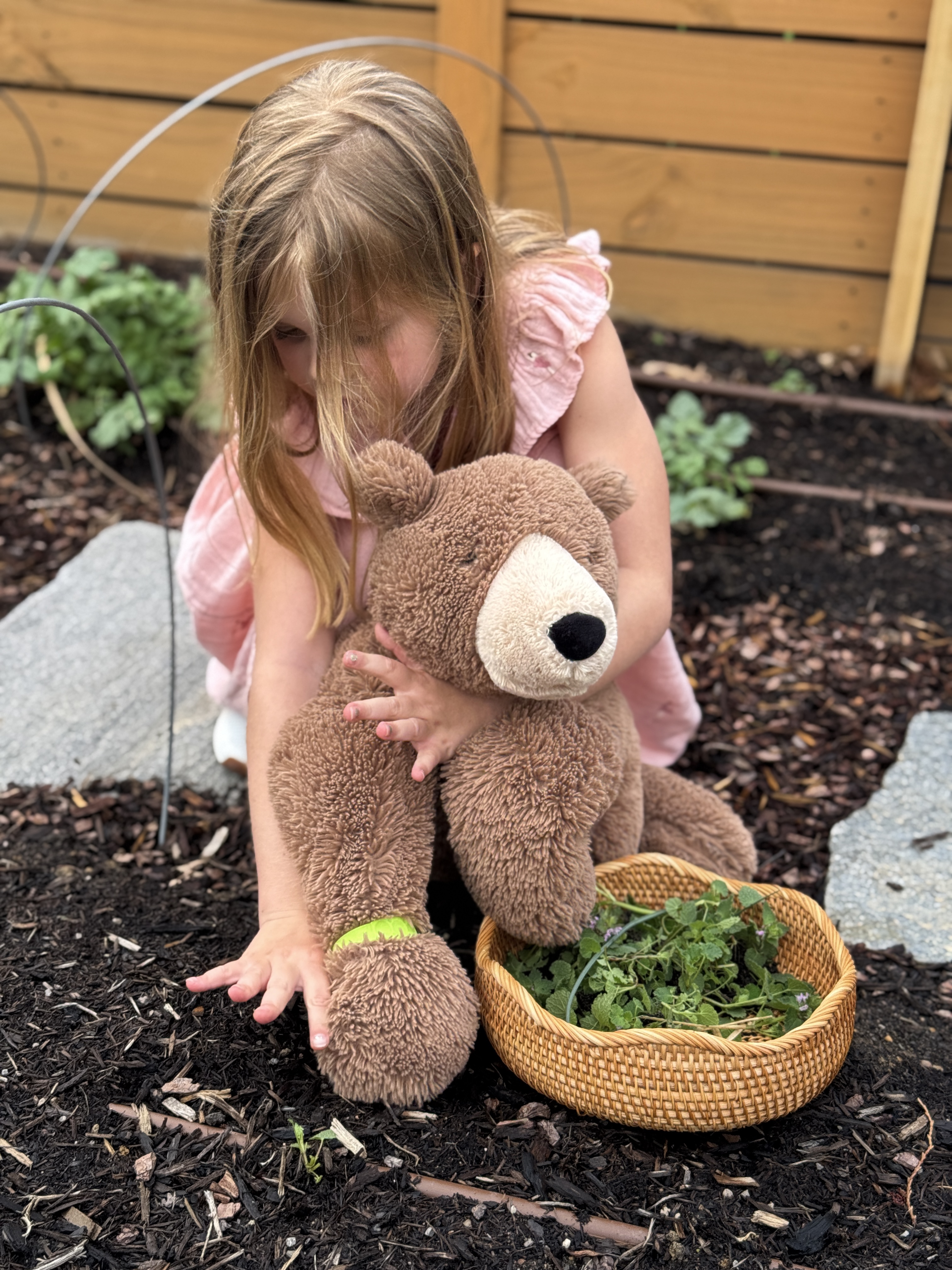
My daughter, Addie, weeding in our garden with her trusty stuffed Bear, Lyle


I had a fascinating conversation with my six-year-old daughter the other day when I was explaining my first assignment for Climate Farm School. I told her that I needed to create a plan for the future of our food system in 2040, and that I thought we needed to start by rebuilding our soil. Her quick and flippant response (very characteristic of a first grader) was, “That’s easy—just don’t put anything bad in it.” When I asked her to elaborate on her solution, she continued, “If you put chemicals in it, things won’t be able to grow as well as they’re supposed to because chemicals hurt the seeds and the dirt. You can put compost in it—fruit peels, apple cores, and other things like that—but no trash! Compost will make the garden grow.”


Sometimes there is truth in the simplest things. She is, of course, correct, and although we grown-ups like to complicate things, the first step to creating a sustainable, healthy, planet-loving, regenerative food system is to not put chemical fertilizers in our soil and to drastically reduce how much we plow it.  Healthy soil needs humidity and structure. Plowing exposes soil to the sun, and pesticides applied to plowed soil kill 70% of the living organisms in it. First, we need to plant “healing plants” such as flowers that accumulate minerals, attract a large biodiversity of animals and insects, and build soil structure. Then we can plant other crops in these more fertile soils and help sequester carbon in the soil, not letting it into the environment. 


I was shocked to learn that food production is responsible for one-quarter of the world’s greenhouse gas emissions (including deforestation, methane from animals and rice, cropland and pasture soils, manure management, and biomass burning). And this unsustainable food system doesn’t even feed everyone nor can it keep up with future demands. So how can we grow more nutrient-dense, better-tasting food and reduce our impact on the planet? There won’t be one single solution that solves the entire climate or food crisis, but rather many solutions that will each solve a portion of it. We need a shift in perspective. 


Essentially, we need to curb our demands on the food system: buy only what we need; grow only what we need; reduce food in landfills; increase our “appetite” for sustainable food. We need to remember that we didn’t inherit this land from our ancestors, but instead we are borrowing it from our grandchildren. I didn’t realize how much of a hippie I was until I left California (ironically) for Ohio. Moving to the Midwest was eye-opening for me on many levels. I am continually shocked at how hard it is to find fresh, local, organic produce in a state that is more than 50% farmland. More than 75% of the arable land in the Midwest is used for corn and soybean production, leaving only 25% dedicated to other crops. The crops that humans eat. Midwestern corn fields are predominantly used to feed cars and cows. If we would devote more resources and land to growing food for humans, not animal feed and automobiles, we could reduce greenhouse gas emissions, feed more people, eat a healthier, more plant-based diet, and take necessary steps towards a regenerative agriculture system that protects our natural ecosystems — one that works WITH the environment instead of against it. As Dr. Jonathan Foley from Project Drawdown has explained, we are trapped in a food system that isn’t the best system for anyone—farmers or eaters. We are also marred by heavy-handed policy that encourages corn production mostly used for biofuels, with government subsidies that give preferential treatment to only a FEW farmers. Our goal should be to allow farmers to do more with what they have available. All the elements and creatures of the land need to work in harmony, not work for the highest yields at the lowest costs.

Here’s what we need to do…

· We need to switch from large-scale, conventional monoculture to farming organic seeds on a fraction of the land, coupled with legislative packages to back up these transitions and an infrastructure to support them.

· We need to create a delicately engineered use of the land that intertwines crops and livestock with wild habitats, even though that might look a bit wild or haphazard.

· We need to gather data inside the soil on nutrients and water levels, so we can reduce unnecessary water use and target the use of fertilizer.

· We need to use farming practices that consider local nuances and promote biodiversity, storing carbon rather than releasing it into the environment. 

· We need to reduce deforestation, which is driven predominantly by animal agriculture 

· We need to create a global shift to more plant-based diets along with huge reductions in food waste and loss

And here are some very important ways that will help us get there…

· Better access FOR EVERYONE to farm-fresh, local, organic produce; if it’s easier to buy nutrient-dense vegetables and they taste better, we’ll eat more of them! Locally in central Ohio, I buy most of my produce from Yellowbird Foodshed, a CSA (community shared agriculture) that aggregates food from many farms in the area and delivers it directly to your door. This way, I support local farmers, I cut out the middle man, and I know exactly where my food is coming from. The Chef’s Garden, also in Ohio, ships their just-picked produce nationwide. 

· More programs like the Edible Schoolyard Project and the Edible Schoolyard Training Program, founded by Alice Waters in Berkley, CA; to truly make an impact on our future, the learning needs to start with our kids, ideally right in their schools.

· Collaboration and knowledge sharing around alternative farming practices that can be profitable, while promoting equality for all farmers, such as the work Leah Penniman is doing at Soul Fire Farm.

· Support for companies like Lundberg rice, who are drastically reforming the rice industry (a common cause of excess water use and greenhouse gas emissions) by using cover crops to restore nutrients to the soil and natural fertilizers from chicken litter.

· More local gardens; I created my backyard garden and greenhouse with the help of the fabulous Katie Carey at Columbus Foodscapes (who always reminds me that we’re “dreaming big!”) to support my culinary business, Croute—artisanal sourdough pizza catering and cooking classes in Columbus, Ohio (@croutefarmhouse on Instagram). My goal is to help bring the farm to the table in Ohio, help people here make better choices about the food they eat, and encourage them to cook more. (Unfortunately, Columbus is the fast-food test market capital of the U.S., and our community is littered with fast-food restaurants at every turn. But this mission helps me get out of bed every morning.)


When I asked my daughter where we should get our food from in the future, she confidently declared, “You shouldn’t go to the store because you don’t know if that food is from a garden. You should either go to a garden and pick carrots and peas and strawberries and eat them from the garden, or you can make your own garden.” And as it turns out, she was right on the nose once again. 

Let’s start the conversation now! I’d love to learn about other ways we can collectively transform our food system. Please share them with me in the comments, if you’re so inclined (I know that you’re all smart and have ideas, just sayin’…)

Cathartic Cobbler

I thought I might be pregnant. When I found out that I wasn’t, I ate peach cobbler for breakfast. It was just sitting there, innocently, on the counter in the new red Le Creuset baking dish I had just bought for this exact dessert. I lifted the foil, slightly pretending I didn’t know what would be hiding underneath it. And then, like magic, there it was. Soft, supple, gooey peach slices, brilliantly shining in their bright orange hue, peaking out from underneath pillowy biscuits glistening with caramelized sugar—all of it half eaten from the dinner party we had a few nights earlier. Tucking into this beauty was exactly what I needed. 

I know it’s absurd to think I might be pregnant. I’m 46. I’ve had three miscarriages, 2 rounds of failed IVF, 4 rounds of IUI, countless herbs and acupuncture appointments, and many, many therapy sessions. My eggs are done. It’s been more than a year since we completed our second IVF session, when a few eggs fertilized but none lasted the six days needed before testing. Even though my brain knew then that my body was done, my heart still hadn’t given up. Every month I would think, “There’s hope. Maybe I’m finally ready. Maybe all the stars aligned this month and our miracle rainbow baby will finally get her start.” Nada. Nothing. Just a lot of sadness and gradually decreasing levels of hope. We’ve been on a waitlist for a donor embryo for nine months. Every month I’m told that there has been no movement on the list. My (now third) fertility doctor has told me in no uncertain terms that I have a less than 1% chance of conceiving with my eggs. My body is getting older, larger, droopier, more tired. But still I thought I could beat the odds and make magic happen. 

This time is different, though. I’m not sure why, but it feels quite final. It feels like the gig is up and I should stop fooling myself. It feels like I should move on—it feels like I NEED to move on. Maybe now my heart will listen to my body and spare me these countless waves of disappointment, heartbreak, and torment. Maybe now I need to focus on finding gratitude for what I DO have and move away from the feelings of regret about what I don’t. Maybe my type A, overachieving personality needs to accept that I can’t put everything I have (and then some) into this and will it to happen. Life’s just not like that. Maybe I need to eat more peach cobbler and just be happy. If only it were that simple.

To those of you struggling with this, too, or something similar—I see you. I feel you. You’re not alone, although it probably feels like that most of the time. I know it does for me. Maybe our combined strength can help us on this journey. Or at least thinking that it can will give me back a little bit of that hope I’m going to move on from now. While I eat peach cobbler. Smothered in ice cream.

PEACH COBBLER

Adapted from Claudia Fleming’s Rhubarb-Rose Cobbler with Rose Cream, The Last Course

Cobbler Dough

1 2/3 cups all-purpose flour

3 tablespoons granulated sugar

1 1/2 tablespoons baking powder

1/2 teaspoon kosher salt

6 tablespoons cold, unsalted butter, cut into small cubes

2/3 cup plus 1 tablespoon heavy cream, divided

2 teaspoons raw sugar, for sprinkling

Peach Filling

3 pounds ripe peaches, pitted and sliced

2/3 cup granulated sugar

3 tablespoons corn starch

1 teaspoon vanilla extract

1/2 teaspoon rose water (optional)

Vanilla ice cream, for serving (optional)

To make the cobbler dough, in the bowl of an electric mixer fitted with the paddle attachment, mix together flour, granulated sugar, baking powder, and salt on medium speed until combined. Add butter pieces and mix until flour resembles course meal. Add the 2/3 cup heavy cream and mix until dough starts to come together. 

Turn dough onto a lightly-floured work surface and gently pat it together. Dust a small baking sheet lightly with flour. Use an ice cream scoop to form dough into about 2-inch size balls and place on prepared baking sheet. (You should have about 8 to 10.) Flatten balls slightly into thick rounds. Cover sheet with plastic wrap and refrigerate for 20 minutes or up to 2 hours. 

Preheat oven to 350°F.

While the dough is chilling, prepare the filling. Combine the peaches, granulated sugar, and cornstarch in a medium bowl and stir until peaches are covered evenly with the dry ingredients. Add vanilla and rose water, if using, and stir gently to combine. Let sit for about 15 minutes.

Transfer filling into a 2 1/2 quart baking dish (I like this pretty one from Le Creuset). Arrange biscuit rounds evenly on top, leaving about 1 inch between them. Brush biscuits with remaining 1 tablespoon heavy cream and sprinkle with raw sugar.

Bake until filling is bubbling and biscuits are golden brown, 40 to 50 minutes. 

Transfer to a cooling rack and cool completely, or until just slightly warm. Serve with ice cream, if desired. 

*BAKER’S NOTE: You can use almost any fruit for this cobbler. Claudia’s recipe calls for rhubarb, but since that has such a short growing season, I’ve been experimenting with other fruits. The rose water isn’t essential but adds a nice floral note to the fruit.

my rotten eggs

My doctor called today to tell me the news I had been dreading. After this, our second round of IVF, none of our embryos had survived. After two years of trying to get pregnant, three miscarriages, four rounds of IUI, two cycles of IVF, a year of acupuncture, six months of Chinese herbs, and countless tests, it was finally clear—we were not going to have another child.

I knew this moment could come. In fact, at almost 45 years old, it was the most likely outcome for me. My eggs are old. Every day that goes by, it is less likely that one will be strong enough. But probability and statistics go out the window when you want something so badly. And when you have hope. As my good friend said today, hope is the only way to stay on this journey. But it doesn’t soften the blow when you get to the end of it.

A lot of people gave me hope on this journey, and I am so grateful for all of them. I flew to NYC twice to work with a fertility doctor there, partly because I’m a homing pigeon for NY but mostly because the doctors in Ohio shook their heads when I suggested IVF. I was old, they said. It wouldn’t work, they said. Why spend all this money for such low odds, they determined. Well, it turns out that they were right. But anyone who truly knows me knows that I’m not easily dissuade. From the very first conversation I had with my NY doctor, she had hope. She had positivity. She radiated the strength I needed to keep going on this seemingly impossible journey. She was my north star.

My husband is my rock. I could fill this page 100 times over and still not have enough words to express my gratitude to have him—a healthy him—in my life. My friends are a network of support I will be eternally grateful for. When I started this journey I could never have imagined how many shoulders I would need to cry on, hands to hold mine along the way, arms to hug me, smiles to help me wipe the tears away.

My acupuncturist and herbalist are my heroes. Their entire beings radiated hope. Not to mention they kept me calm and balanced through everything. My yoga teachers were a godsend. I still remember the day one of them suggested that I stop trying to make myself feel a certain way or think a certain way, and to just sit with whatever I was feeling—only then could I really be in it. That seemingly simple piece of advice changed my life, and my outlook on everything. We all try too hard to make ourselves feel a certain way and then feel guilty when we can’t. I catch myself doing it all the time, but now I pay more attention to that ping pong game inside my head. I tell myself that I should be grateful for X or joyous about Y—but does any of that really erase the pain and heartache of other situations? No. Does masking or hiding your feelings really make them go away? No. Does telling yourself to be OK with whatever happens really make you OK with whatever happens? Definitely not. As the wise and wonderful Deepak Chopra says, “Nobody can change their mind by trying to change their mind. Nobody can get rid of a thought by using a thought.” What I’ve realized is, I can be grateful for the wonderful, amazing, and joyous daughter we have and still feel pain that we won’t have any more. I can appreciate all of the love I have in my life and still be f–ing pissed that my husband got cancer, that both of my parents died, that my mother-in-law is very sick, that Covid happened, that I’ve lost three pregnancies, etc. etc. etc. So if there is anything positive that I can take away from this journey, it’s the liberation of giving myself permission to feel what I feel, think what I think, and be who I am and not putting pressure on myself to feel, think, or be anything else.

So maybe that’s the reason I’m even sitting here today, writing about my rotten eggs and our painful journey. To share that guiding philosophy with you and hope you might find some liberation from it, too. Be kind to yourself. I’m going to try to be, too.

this virus stole my heart and soul

Sometimes I think Ohio is cursed for us. We’ve only lived here for two years, but in the past 18 months alone the pandemic started, we lost a pregnancy, my husband was diagnosed with cancer, my father died, we lost another pregnancy, and now the latest bomb has hit—we all have COVID.

At first I thought—I hoped—I was pregnant. I was debilitatingly tired and generally run down, both classic signs of early pregnancy. My throat began to hurt a little, but when I started sneezing, I thought it was allergies. Sneezing, I might note, is not on any list of symptoms anywhere, so there’s that. But when I lost my sense of smell and taste, I knew that the virus I had been hiding in fear of since last March had finally found me. And it hit me where I live.

Since that fatal day, my husband’s and my symptoms have run the gamut, and we’ve pretty much covered off everything on every list between us. Even though we are both fully vaccinated, he developed classic flu-like symptoms: chills, fever, muscle aches, congestion, cough, night sweats, and pretty much felt like he was dying (his words). I’ve had horrible sinus headaches, mind-numbing fatigue, severe leg cramps (likely from dehydration), and have not been able to smell or taste anything for six days. While the latter might seem like nothing, it is everything to someone who cooks for a living. It’s my heart and soul. Not being able to feed the people I love or enjoy the seemingly simple pleasures of my favorite foods, especially during this insanely stressful time, is some sort of cruel and unusual punishment. I can’t taste the warmth and comfort of the giant pot of chicken soup I made on Saturday, I can’t smell the brownies my daughter and I made together baking in the oven, I can’t even enjoy a cup of hot coffee after a horrible night’s sleep (although I did have to force one down yesterday, which felt like mud, since I hadn’t pooped in three days and needed a kick start). Even outside the kitchen, this beast is rearing its ugly head. Showers are no longer soothing, since I can’t smell any of the wonderful soaps and shampoos that quite literally wash the day away. And worst of all, I can’t smell my daughter’s freshly-bathed hair. Boy do I love that smell. It keeps me going on even on the hardest days. I know what you’re thinking—at least none of us are in the hospital, at least none of us are on ventilators, at least it’s not worse. But if there’s one thing I’ve learned from losing both of my parents in the past two years, at least doesn’t always help. One positive attribute doesn’t necessarily erase a negative one or make it hurt any less. (When I’m grieving, please don’t constantly try to dig me out of my dark hole and bring me into the light with you. Please come into my hole with me and just give me a big hug.)

Speaking of hugs, at least we’re all quarantined together so I can squeeze out every hug possible from my adorable little pumpkin, who keeps asking me, “Mama, you still sick? I hope you feel better soon, Mama.” She has mostly been asymptomatic through this whole ordeal, with a slight runny nose that occasionally becomes stuffy. Although she’s probably sick of me following her around like a hawk, incessantly asking her if she has ouchies anywhere, if her throat hurts, if she can taste her food, etc. etc. etc. Of course I freaked out when her pediatrician said I especially need to watch her in 3-4 weeks when more serious respiratory issues can develop in toddlers. Of course this is nowhere close to being over.

The one aspect I drastically underestimated was the emotional toll this is taking on all of us, and on me especially. Just when we had hit the point of being so beaten down that we couldn’t bear another punch, this beast came along and knocked us out of the ring. In addition to all of the physical pain, there is a horrible mental stigma of being the first in our daughter’s classroom with a positive test. It feels like I’m wearing a scarlet letter, even though the letter that was sent to the entire school doesn’t identify who we are. What kills me is not only how diligent we’ve been about masks, social distancing, washing hands, basically having no life (which is pretty easy to do when you only have four friends between you), but that we are and have been so freaked out by this disease that my husband and I paid $400 to get PCR test results in 30 minutes, because testing in Franklin County, Ohio is absolutely absurd. You can’t get an appointment for DAYS and then you can’t get results for DAYS after that, unless you pay. (But that’s a soap box for another day.) Then we rushed our daughter to her pediatrician to confirm our worst nightmare, only to now be the trailblazers wearing the scarlet letter. As painful and nauseating as it is, I stand by our decision to know what was going on and not sit idly by hoping for the best, as I’m sure many others might do. I get it, this sh*t is cray, and it can get the best of your otherwise rational intelligence and emotions. Is it better to face the enemy head on without any weapons, or hide behind a stone wall hoping he doesn’t see you or can’t climb over it. Since my daughter is preoccupied with monsters these days (welcome to age three), it only seems to be a fitting comparison with our life. While we don’t want there to be monsters under our beds, and we know that most of the time there aren’t any, once every 100 years they come out and find us.

Sadly, I don’t have any words of wisdom and I certainly can’t figure out why the universe is testing us this much lately. But I will say, please savor that cup of coffee this morning, relish that first bite of brownie, smell your kids’ hair every chance you get. Hopefully I’ll be able to again in a few weeks, and hopefully I’ll be back at full power—although I’ve heard many stories that taste and smell might not fully return. As they say, I’ll cross that bridge…. and just hope there aren’t any monsters hiding underneath it.

Stay safe, my friends.

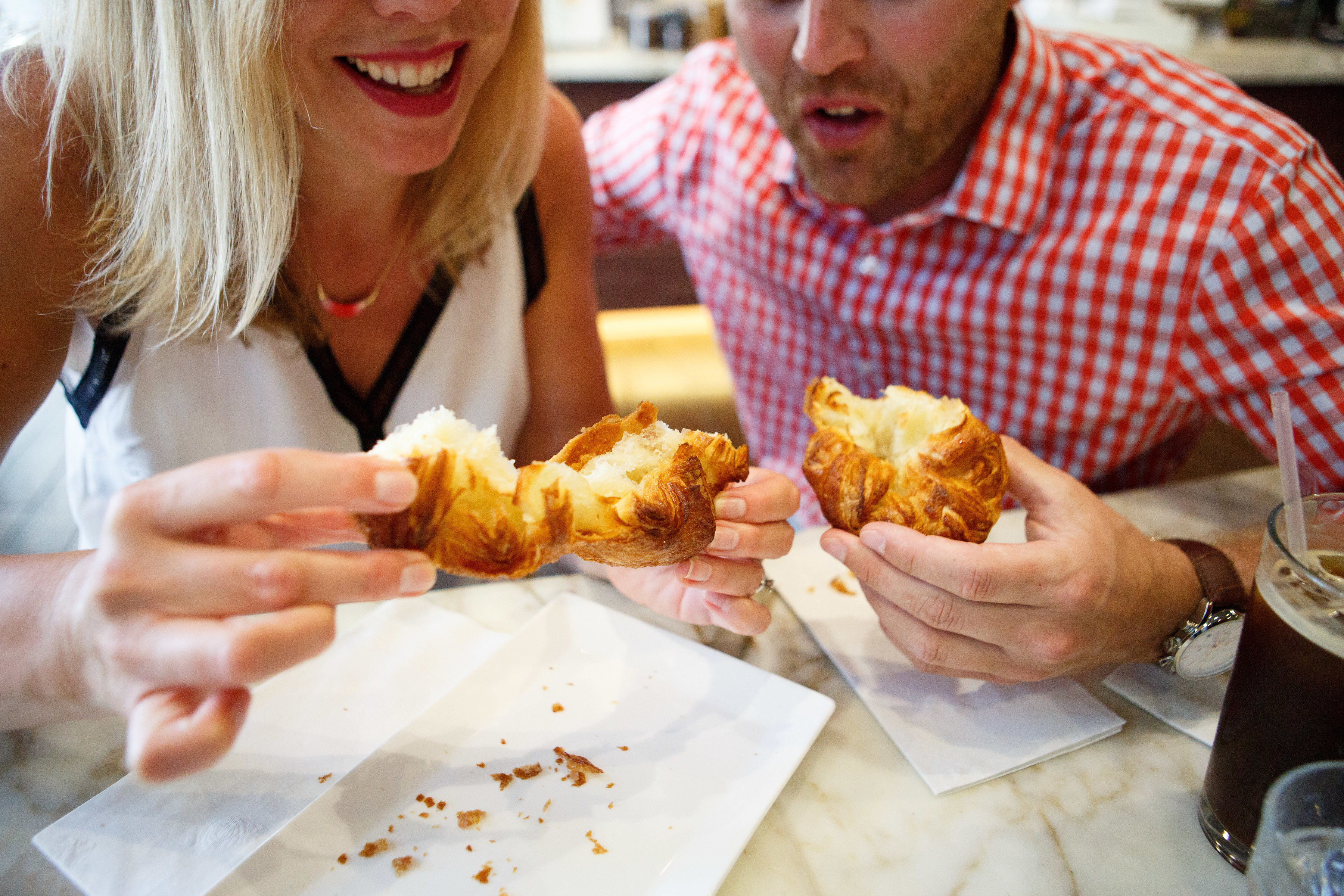
Excitedly about to tuck into a Kouign Aman during our happy life in San Francisco

inspiration for 2021

On April 14, 2016, I wrote a post wondering if you could really reinvent yourself. Almost five years later, I’m (finally!) beginning to think you can. A few months ago, I was a guest on Lesley Jane Seymour’s Reinvent Yourself podcast. She titled it, “When not having a plan is the best plan,” which couldn’t be a more accurate summary of the last few years of my life. Listening to my episode was a very emotional experience. We’ve all heard the expression that it’s the journey, not the destination, that matters. I guess it took being an observer of my own life for that mantra to really resonate. So I’ve decided to use it as my inspiration for what’s ahead.

I realized today that I haven’t written a post in almost a year. I’ve been writing other things (all of you air fryer and Instant Pot lovers can find brand my new cookbook, Air Frying with Instant Pot, at Williams Sonoma and Target now), but I haven’t done much for myself. 2020 was a pretty sh*tty year. In addition to all of the hardship, pain, and sadness the world is facing, I lost (another) pregnancy and my husband was diagnosed with cancer. (If you aren’t already, you should absolutely follow his journey at checkyourbutt.com.) Needless to say, we’re ready for some lightness in 2021. Moving to Ohio, right before a global pandemic no less, has been a challenge. I find myself yearning for inspiration, craving good food, and desperately looking for something to get me excited. But the other day I realized I need to stop looking all around me for it. As hippy dippy trippy yogi as it sounds, I need to look inside—and at my own journey—to find it. So, I’m going to do just that. You have my word. When I think about what I really want to do with my life, why I’m doing all of this, it’s to help others build a stronger connection to food. To the food they eat, to the food they cook, to the food they serve others. So to that end, I’m going to focus a lot of 2021 on teaching. (Thank you, Zoom, for making that possible during a pandemic.) Stay tuned for more information about my new, donation-based online cooking classes—in honor of my husband’s courageous journey, half of the proceeds will be donated to colorectal cancer organizations. I hope you’ll join me. It’s gonna be great.

Oh, and for those of you who read my reinvent yourself post back in 2016 about the Williams Sonoma cookbook shelf, I can now proudly say that I did it. I got myself onto that shelf. In spades 🙂

Happy New Year—may this year bring you love, light, and the inspiration you’re craving.

The Williams Sonoma cookbook shelf today

2019

For most of 2019, I thought it was a shitty year. My mom died 16 days into it, and nothing could really make up for that loss. Or so I thought. Last night when I was watching cute videos of my daughter on my phone, I realized that Apple had made a movie of my 2019 — Year in Review, 2019. So I watched it. And I cried. And I cried and cried and cried. And then I realized that this movie, which my phone just created on its own through Apple’s intelligent machine-learning software, proved me wrong. The movie essentially personifies the popular adage: Life is what happens when you’re making other plans. I literally watched my daughter grow up before my eyes. I melted when I saw so many faces that are such a huge part of my life. I laughed when I relived so many joyous moments and so many amazing smiles. And I cried when I watched it all come together in just one year, such a seemingly short time but such an important and amazing one. Sometimes it just takes a little piece of technology to remember the human side of life. I am blessed. 2019 wasn’t so shitty after all.

can you text heaven?

My mom knitted sweaters for countless new babies. She knitted them so large that it would take YEARS before they fit, but that was her pragmatic German side coming through. “Pooch (her nickname for me), you don’t want them to grow out of the sweater so quickly!” She was right. Sadly, Mom was never able to knit a sweater for my daughter. By the time we found out Addie was on the way, her fingers were so messed up from the neuropathy that she could barely write, let alone knit.

This morning, a close friend sent me a picture of his daughter in her sweater—a beautiful, thick red cardigan. She’s just about to start first grade and it finally fits her. The photo simultaneously made me smile and cry. After Mom passed away, I was looking through her address book and found my friend’s daughter’s name in it. Not his, but his daughter’s. His daughter always held a special place in Mom’s heart, even though they never met in person. This was true for a lot of little ones—my mom was a surrogate Oma (grandma in German) to countless kids, even if she never met them. My friend told me that his little pumpkin remembers my mom had knit her that sweater, and remembered that it was too big on her for many years. At that moment, all I wanted to do was text the picture to my mom and tell her that. But how can you text heaven?

Addie and her rolls, out for a walk in the pram her daddy used to stroll around in

Addie is 9-months old now and getting so big. Her rolls are remarkable. She recently decided she no longer wants to nurse, which makes me sad. For some reason, I always thought it would be my decision to stop nursing. I don’t know why but maybe I just wanted—or needed—to control something on this crazy journey of motherhood. It goes without saying that raising a baby is far from easy, but nursing one is absolutely crazy town. I just read an article in the NY Times where the author paints a picture of how she thought nursing would go.

“When I was pregnant and I imagined myself breast-feeding, I usually pictured myself out to brunch with some friends. When the baby was hungry I’d pop on my color-coordinated nursing cover, and she’d latch right on while I enjoyed my mascarpone French toast. That’s not what it was like at all.”

Ha. Brilliant. I couldn’t have said it better myself. My mom, unfortunately, played into that myth by constantly reminding me she breast-fed me until I was three, and that she had more milk than she knew what to do with! Thanks, Mom. It didn’t work out that way for Addie and me. My labor was rough, I lost a lot of blood, and that led to my milk production being very, very low. But how does one even know that? Until a horrible lactation consultant tells you that you’re hurting your baby’s brain development, shoves a bottle of formula in her mouth without asking, and you end up in tears in a sterile, cold doctor’s office, battling no sleep, a sick mother on the opposite coast, and the worst California wildfires in years outside your window. It sucked. Mascarpone French toast, it was not.

I wish more people talked about how difficult the breast-feeding journey is. I still don’t understand why our culture has such taboos around such natural things like breast-feeding and miscarriage. Addie’s nanny is from El Salvador and it’s amazing how differently they handle things, especially feeding. They have a community who supports each other. They have a tribe. Where is our tribe? Why does our culture strive for all aspects of life to be Instagram-worthy perfection? Last week, I spent my entire grief counseling session crying—mostly about my decreased milk production, how sad it makes me that Addie no longer wants to nurse, and how hard it is to maintain pumping throughout the day, even when she is right next to me because she shakes her head furiously when I put her near my boobs. In El Salvador, they don’t even have breast pumps. How did we get here? I wish our bougie breast-feeding class had even touched on one aspect of this part of the journey. But sadly, it was mostly propaganda for breast-feeding, to which I wanted to jump up and shout, “Why would we be here paying all this money if we didn’t want to breast-feed!” Last week I wanted more than anything to call my mom, but unfortunately, I haven’t found the phone number for heaven yet.

When I encounter this gut-wrenching sadness about missing Mom, I try to remember that her sweaters are bringing joy all over the world. When I was putting together the video for her memorial, I received photos of kids in her sweaters from as close as New Jersey to as far away as New Zealand. That makes me smile. Dozens of kids, many of whom never even met my mom, know her and remember her. That is exactly the legacy that she wanted to leave on this world. I know she can see them and is smiling at all their joy. I’m pretty sure they have cameras in heaven.

i wrote a cookbook…or two

In the very first issue I worked on for the very first magazine I worked at, I got to write the captions for a fashion feature. I didn’t know it at the time, but that was a big deal. A very big deal. Editorial assistants, let alone fashion assistants like me, never got to write anything. We made photocopies, we sent faxes (yes, faxes), we answered phone calls (yes, land lines), and we organized the mail. I did work on the computer, too, since I was the only one in the fashion department who had a computer (due to the fact that I was really the only one in the department who knew how to use a computer). I created databases for contacts and organized images of fashion shows into folders, all for naught since old-fashioned Rolodexes and giant drawers of slides from the shows reigned supreme. This was 1999 after all. But I was an eager beaver, over-achieving NYC girl fresh off the boat from college, so I jumped in head first and convinced the fashion features editor to let me help her with the article since she was so busy. It worked. It was an article about how fashion mimicked art and it couldn’t have been more in my wheelhouse. I researched those captions with abandon and handed my work in with pride — and with all my research attached. The editor laughed a little but seemed very appreciative. And so it went, the first writing I ever did that went to print.

Luckily for me, the fashion magazine I was working at, Mirabella, started a home section while I was there and needed someone to — you guessed it — write the captions for those stories. I got to attend photo shoots in some of the most fabulous apartments in NYC and meet some of the most fabulous women in NYC (most of whom I was too young to appreciate at the time), and then run around the city looking for the furniture they had in their homes so our readers could buy it, too. (The modern pieces were easy to source, the Louis XIV vintage, velvet-covered furniture, not so much.) But once again, I approached writing those captions with abandon and loved my job. My 12-hours a day, eat baked potatoes at every meal, $20K a year job. Because I got to write captions. 

Fast forward 20 years to today, past my jump into the “Internet” and all the jobs that followed, which thankfully paid more than $20K a year (some only slightly more), and the countless captions, articles, and video scripts I wrote over those years. My most memorable and proud writing feats included interviewing Rihanna, LeAnn Rimes, and Kiera Knightly (all in person!) during my days as a teen magazine editor. But then something happened. As I climbed up the corporate ladder to becoming an executive, moving to London and then to San Francisco to further my career, I somehow stopped writing. There was no time for that anymore. I had teams to do that now. I had too many brainstorms and budgets and board meetings to prepare for. I loved my jobs but I missed writing, and I was too busy to even realize it. When life at work got stressful, I baked scones in the office kitchen that was meant for video shoots. (No one really minded because, well, hot scones.) But it wasn’t enough. I left my corporate life behind, moved to Ireland to live on a farm, and learned to cook properly. I started a blog, mostly just to remember what I cooked and how to cook it! When I returned stateside, I had no idea what to do with me life. Strangely, writing didn’t even occur to me. But then a friend called me up to help her cook for a photo shoot, and serendipitously my new life began. I met an editor on that photo shoot who was about to go to the same cooking school in Ireland I had just returned from (some could call it coincidence, but I call it fate), and without even realizing it, I was on a path back to writing again. 

My first cookbook was published last October, a week before my daughter was born. The day I went into labor, I went into the Williams Sonoma store on Chestnut Street in San Francisco and saw it on display. It didn’t seem real. But my husband was with me to witness that it was. (Maybe the excitement sent me into labor?!) 

I have been rubbish about telling people I wrote a cookbook. I blame the sleep deprivation and altered state of reality that comes with having a newborn. Some friends text me pictures from Williams Sonoma stores and say, “You wrote a book?!” Others ask me if I have any good recipes for the Instant Pot and I say yes, in fact, I wrote a whole book with recipes for the Instant Pot. I also hear many stories about people being too scared to take their Instant Pots out of the box (Ina Garten included), so I tell them that I was on a video series called That Expert Show where I explain how to use it and highlight some recipes to help them get started. But since my second cookbook is now in Williams Sonoma stores, I thought it was about time I stopped being so rubbish about telling people I wrote a cookbook. Or two. 

My mom passed away in January and I think about her a lot. She loved my blog. She always asked me to print it for her so she could have it in a book. No matter how much I explained that was counter intuitive to the digital medium of a blog, she didn’t care. She wanted it printed. She wanted to hold it. She always said to me, “You are such a beautiful writer, you missed your calling.” 

By the time I could give her a copy of my first cookbook, she was too sick to read it. But I take comfort in the fact that she knew I had written it, and she was finally able to hold a book I had written. She never opened it, but she knew what I had accomplished. I knew she was proud of me, and that gave me the permission to be proud of myself. And to tell people what I have accomplished (and to tell them to take their Instant Pots out of the box!). I’m writing a third book in the series now, and my daughter is finally old enough to eat some of the dishes from it. Life is coming full circle and writing is fulfilling me on new levels that I never even thought possible. Well, Mom, I guess I didn’t miss my calling after all.

Everyday Instant Pot and Healthy Instant Pot are available at Williams Sonoma stores, on williams-sonoma.com and amazon.com

a letter to my mom on my first Mother’s Day

Dear Mom,
I never thought that my first Mother’s Day would be so bittersweet. As I look my beautiful daughter in her curious, wide eyes, and truly feel for the first time what it’s like to love so much, I look around for you to share it with, but you’re not here. 

I miss you. I miss your love. I miss your hugs. I miss your German accent. I miss your innocent smile (the one you gave even when you were up to something mischievous). Addie has the same smile. She has a lot of you in her. 

The other night I dreamt that you were still with us. We were having a party at your house and you said that all you had to do was “push the toxins out of my body and then I was cured.” I wish it were that easy. I wish it happened that way. But boy did you give cancer a good fight. Always with a smile. Always with everything you had. Always with your face on. Because why go to chemo without your face on, decked out in a stylish hat and Tiffany jewels. You are such a classy lady, I can only hope I’ll be half as classy as you are some day. 

I wish you could have had more time with Addie. That’s my biggest regret. She’s amazing. Her laugh is infectious and her smile can light up a room. Kind of like you. You would love her. And I know she would have loved you in all your Oma glory. As I write this, I am sitting in the park with Addie sleeping in her stroller on a sunny San Francisco day, crying that you’re not here with us. I cry a lot these days. I’m often struck by waves of emptiness, a feeling I have never experienced before in this way. It’s different than missing you. Because if it was just missing you, I would know I could see you again one day. But I know I can’t. I’ll only see you in pictures and in my mind. And that will have to suffice. 

So many beautiful Mother’s Day photos and sentiments on Facebook. You loved Facebook. You were hilarious at Facebook. There will never be anyone like you on Facebook ever again, that is for sure. You could bring people joy even on Facebook. You were one of a kind. I know your bedroom has shoeboxes full of cards I gave you through the years. One day I might be able to bring myself to go through them. Not yet. But I did find this watercolor painting I gave you when I was really young. It was in a pile of bills and documents I was going through after you died. It was in a box near the couch where you left everything as if you had just gotten up to go get groceries. I don’t think you knew you would never come back to that couch. I don’t think you knew you would never come back home to Dad. I don’t think you knew you would never be able to hug us again. I didn’t either. You left us too soon. Before I could even say goodbye to you in person. Knowing you, you probably did that on purpose. You probably didn’t want me to see you without your face on. But what you probably didn’t realize is that I will always see what is behind that stunning face. Your heart, your soul, your tenacity, your strength, your courage, your strong will, and your endless love.

I love you, too.